
Electrical conduits are metal, plastic or fiber pipes designed to protect electrical cables and wires. They’re used in just about every residential and commercial establishment, especially for wiring that is either exposed, or fitted outdoors. Since they are essentially a safety feature, you should select the material, size and fittings based on the environment of the installation and the type of wiring it’ll be housing.
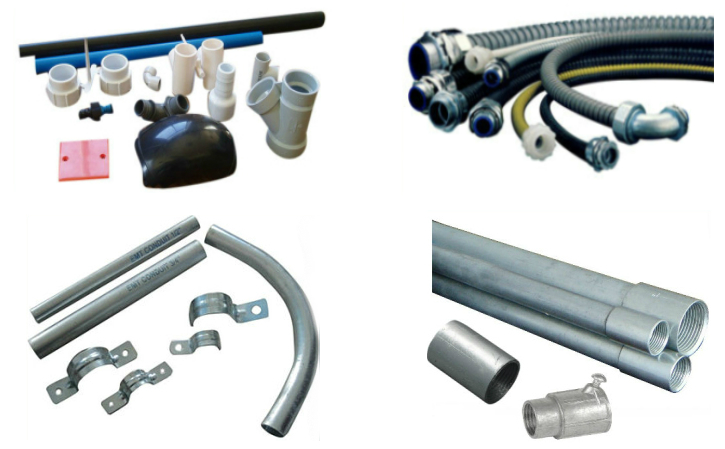
Types of Electrical Conduits
When it comes to options, there are almost as many types of conduits as there are wires and cables, and they can be broadly classified into metallic and nonmetallic variants. Here are some of the most common types under these categories:
Metallic Conduits
Non-Metallic Conduits
To ensure the conduit system meets the requirements of regulatory authorities, safety standards and local building codes, you need to take into account the conditions at the installation location, as well as the method of installation. Some installations may also require different types of conduits to be used in the same system.
Conduit Fittings
Conduit fittings are available in a huge variety of sizes, shapes and materials, and they’re normally used for connecting runs of conduit together, and for connecting conduit ends to boxes, enclosures or electrical devices. Fittings are needed to connect conduits to boxes or enclosures of different sizes and when the direction of most metallic conduits has to be changed. There are also straps and clamps, which are used to provide additional support to conduits and to keep them secured. You may need to use special types of fittings if a conduit run is likely to be exposed to moisture, vapors, or hazardous conditions.
Types of Electrical Fittings
Section 110-3 of the NEC requires all the components to be listed and labelled, so all listed parts meet certain construction and performance requirements. However, the Code does not specify the electrical material used for the fittings, of which there are several. This will be determined by availability, design considerations or personal preference. If you’re unsure about how the conditions will affect the fittings, you can contact a manufacturer with details of your application, consult a local distributor, or get an engineering recommendation.
Electrical Conduit fittings can be listed as follows, based on the function they serve and how they are installed:
-

Conduit Bodies
These are tubular units with openings at each end for admitting conduits, and providing access to the wires. There are quite a few designs and you’ll find conduit bodies that connect two conduits in a straight line, create 90° bends and join two different types or sizes of conduit. Even the access point for the wires can either be exposed, or have a cover with screws. Since conduit bodies can perform such a wide range of functions, and some are also intended to be used as pull-boxes, they are marked with the purposes they are rated to serve, as well as the internal volume.
-

Bends
To save time, equipment and labor costs, you can tackle changes in the direction of a conduit with pre-fabricated bends. Commonly called ‘factory bends’ or ‘elbows’, they are available in a variety of lengths and curvatures, and according to NEC requirements, you can bend certain tubings by hand, using a mechanical bender, or a hydraulic bender for larger ones. However, an installation may require a lot of bends, and bending conduits on location might damage them or reduce the internal diameter. Even with the use of factory bends, the NEC does restrict the number of bends you can have between pull boxes to a maximum of 360°, including offsets at the box or enclosure.
-

Coupling
Conduit couplings are essential for almost any coupling system, for securely linking together lengths of conduit and attaching site-fabricated bends. Even though PVC conduits with a belled side can be linked without couplings, they would still be needed for sections where the conduit has been cut to size. Couplings are available in a variety of sizes and some of them, like rigid conduit couplings, are threaded on the inside. However, when the conduit is passing through a wall or making some other transition, consider using a conduit body instead. Even for the first sections of conduit entering or leaving the box or enclosure, use pullboxes or bodies so the conductors can easily be retracted if the enclosure needs to be removed.
-

Drains
In areas where the temperature varies significantly, or the conduit runs from a warm area to a cooler one, moisture in the air starts condensing. To prevent drips and water-logging in the conduit runs, install drains at the lowest points of each run that might be affected, or at locations where water might get trapped and accumulate. For embedded and buried conduits, installing a run within the encased part may be difficult. You can create a low-point or a dip just before the conduit goes underground and install a drain there.
-

Bushings and Locknuts
Bushings create a smooth entry point to conduits without any sharp edges, protecting the conductors from damage during wire pulls. They are also extremely important when the conduit system enters an enclosure or bus box. A bushing is installed on the inside of the box opening and threaded into the conduit end, separating the conductors from the edges of both the opening and the conduit end. Locknuts are threaded on the inside, with teeth on one surface or both, which grip the surface. They installed on both sides of the opening to ensure that both the conduit and bushing are held firmly in place. If the locknut has teeth on only one side, that side should face the box.
-

Unions
Conduits often run along areas where space is constrained and couplings are difficult to install. Apart from that, sections might at some point get damaged, which is where unions are very useful. They have two separate heads and a locking mechanism which can connect two pieces of conduit together, even if they can’t be physically turned. Unions are available in different configurations with male and female heads, or a combination of both. The heads can be fit on each individual conduit end and secured together, usually with a surface nut that slips over the two parts and locks them together.
-

Nipples and Hubs
Nipples can save time and money when a conduit is needed between enclosures that are placed closed to each other, or for short runs where field-threading the ends of a conduit is difficult. Like prefabricated bends, nipples are threaded on both ends and can be installed quickly and easily. As per the NEC, a nipple cannot exceed 24 inches in length, beyond which it is considered a raceway and can only be used for three current carrying conductors. Hubs are used to connect conduits to bus boxes or enclosures that don’t have a factory-threaded entry.
-

Reducers and Reducing Washers
A reducer is a special kind of combination coupling that allows you to connect raceways of one trade size to larger or smaller ones. Although it’s generally better to use a pull box, reducers are handy for areas that have limited space. Reducing washers, or threaded reducers, are similar to hubs, except both the inner and outer surfaces are threaded. They are used to connect conduits to enclosure or box openings that have a larger diameter, with locknuts on both sides to fasten them in place.
-

Straps and Clamps
Long runs of conduit and tubing require additional support to keep them from sagging or breaking under their own weight. Straps are used to mount the conduit to ceilings or walls using a screws or bolts. To fasten conduit runs to fixed structures, like beams, hangers or unistrut channels, the conduit is supported using clamps. For most installations, the NEC specifies the maximum length of unsupported RMC and EMT running in a straight line as 10 feet, and within three or five feet of a box. For liquidtight flexible conduits, this reduces to every 4.5 feet of conduit length and within 12 inches of a box or enclosure.
If you have any questions please contact us by phone, fax, email or by completing our online contact form.
Contact UsFAQs
1. What does conduit serve in electrical wiring?
There are multiple benefits to utilizing an electrical conduit. It protects the wires by enclosing them in a sturdy tube, preventing damage or exposure to harmful conditions. This reduces the chances of electric shocks and fires resulting from faulty wiring. Electrical conduits can also be utilized for organizing and decluttering purposes, as they allow multiple cables to be routed in one location. Additionally, they offer an attractive aesthetic element to any project due to their wide range of colors and sizes.
2. How deep must electrical conduit be buried?
In most cases, it’s recommended to bury conduit at least 18 inches deep. However, there may be some exceptions where it needs to be buried even deeper.
3. What are some common types of electrical conduit?
You can find electrical conduits in various materials such as aluminum, steel, PVC (polyvinyl chloride), and flexible conduits.
4. How do you bend an electrical conduit?
You can bend electrical conduit like an expert if you follow these simple instructions:
Step 1 – Calculate your conduit bend’s exact angle and position to ensure an accurate and professional installation.
Step 2 – On the conduit, mark the calculated bend point. During the bending process, this can serve as a guide.
Step 3 – Carefully apply pressure to the designated place with a conduit bender and gradually bend the conduit to the appropriate angle.
Step 4 – Double-check your work when the bending procedure is finished. Check for kinks and deformities in the conduit and ensure it is at the proper angle.
5. How to Connect PVC Conduit to Electrical Box?
Follow these easy instructions to connect PVC conduit to the electrical box:-
- Before you begin, switch off the power to the circuit.
- Using a hacksaw or PVC pipe cutter, measure and cut the PVC conduit to the necessary length.
- Remove any rough edges or burrs from the cut end of the conduit with a deburring tool or a utility knife.
- Slide the proper fittings onto the conduit. A male adapter and a locknut are required for a standard connection to an electrical box.
- Apply PVC cement to the inside of the female threads on the electrical box and the exterior of the male adapter.
- Tighten the male adapter into the female threads on the electrical box.
- Once the conduit is attached to the electrical box, use a fish tape or a wire-pulling tool to fish the wiring through the conduit. To avoid harming the wires, take your time and be gentle.
6. What types of wires were used with conduits?
THHN and THWN are the two most popular wire kinds used within a conduit. These wires are insulated, color-coded, and available in single strands. They resemble the wires seen when the outer coating of the NM cable is removed.
7. Is it okay to use white PVC for electrical conduit?
According to the NFPA/NEC codes, using “white” plumbing PVC for electrical raceways is not advisable. This is because “grey” electrical PVC is UV resistant, while “white” plumbing PVC is not. UL (Underwriters Laboratory) designates “grey” PVC as an authorized electrical raceway.
8. Are electrical conduits and BX wires the same thing?
At first glance, an electrical conduit might look like a BX wire. The BX wire is often known as AC wiring for “armored cable” or MC wiring for “metal cable.” Both AC and MC wiring have individual wires enclosed in a metal casing, similar to the conduit. However, there is a key difference – While conduit can be used in exposed and moist areas, armored cable should not be used in wet locations. These places are prone to corrosive conditions where damage could occur, as stated in the electrical code (NEC 320.12)
9. Is conduit required for electrical lines in walls?
You’ll likely want to use a conduit when running electrical wires through walls. It’s imperative because it helps protect the wires from damage or fire hazards. And if you are extending cables outdoors, using conduit to shield them from the unpredictable weather is crucial.
10. Is it necessary to run 220v wiring through a conduit?
Protecting the wires for your 220 lines is essential to keep yourself safe from harm. Exposing them outside your walls can lead to severe injury or death. So, grab some stiff metal conduit long enough to go from the side of your breaker box to the hole you made in the wall. Then, securely fasten it with conduit straps every 1-2 feet (30-61 cm). This way, you can ensure that your wires are well-protected.
11. What is the strength of an electrical conduit?
The conduit has a minimum yield strength of 30,000 psi. This ensures that the conduit doesn’t “neck down” while being installed, which could cause damage to the cable or conductors.